


Walking for wellness: how rambling boosts physical and mental health
Explore the latest research into walking and health to maximise the wellbeing benefits of your walks
Words: Annabel Streets
Studies repeatedly show that regularly walking in nature boosts both physical and mental health, but how can we maximise these wellbeing benefits? Recent research reveals that the choices we make about the length, timing, frequency and location of our walks can dramatically affect their impact on our health
Ramblers members know that walking is one of the best things we can do for our health, longevity and mental wellbeing. But could we be squeezing more from our saunters? Yes, say scientists, whose latest studies are providing new answers to those perennial questions: How far should I walk? How fast should I walk? How often? At what time of day? Where? And does how I walk have any bearing on the health benefits?
While all walking is good, not all walking is equal. Anyone who’s walked long-distance, uphill, at speed, in the rain, carrying a heavy pack, knows this is a very different experience from gently pottering round a sunny park. So, it will come as no surprise to ramblers that there are dozens of ways to optimise our daily yomp.
Footstep figures: should I walk 10,000 steps a day?
Let’s start with the numbers. Step counting (using a fitness tracker, smartphone, smartwatch or pedometer) is an easy way to check that our walking is working to full effect. Studies suggest that every 1,000 extra steps we take beyond 2,500 a day progressively reduces our risk of mortality from all causes by around 12%. So, my first suggestion is simply to walk more.
What about the recommendation of walking 10,000 steps a day? This was dreamt up by a Japanese marketing company in the 1960s to promote an early pedometer. But work carried out by Janet Lord, emeritus professor of immune cell biology at the University of Birmingham, indicates that 10,000 steps does indeed have dramatic benefits. In a recent interview, Professor Lord noted that 5,000-7,000 daily steps halved inflammaging and that 10,000 steps eradicated it. Inflammaging describes chronic inflammation that develops as we age, believed to accelerate the ageing process and contribute to various health conditions. Temporary inflammation is a healthy part of the healing process when we have an injury or illness, but with chronic inflammation, swelling or soreness persist and cause harm. Lord thinks inflammaging lies at the heart of most diseases of ageing – including heart disease, arthritis and dementia. If you want to age well, aim for a daily 10,000 steps.
The same goes for maintaining a good mood and sharp brain. A growing number of psychiatrists and neurologists suspect much mental illness might result from inflammation in the brain, known as neuroinflammation. They speculate that it disrupts brain function, affecting mood, behaviour and cognition. So, those 10,000 daily steps could improve your mental health as much as your physical health.
What about walking beyond 10,000 steps a day? Most studies show benefits plateau at 10,000 steps. But a recent study found that people walking around 13km/ 8 miles a day – around 16,000 steps for the average adult – had the longest life expectancy of all.
Scheduling strolls: how timing impacts the health benefits of walking
Of course, we should walk whenever suits our schedule. But sweet spots in the time of day are emerging from the data.
An early morning walk is particularly good for us (all dogs know this!) because the high proportion of blue light tells our brain that it’s time to wake up. Our bodies respond by turning off sleep-inducing melatonin and producing biochemicals like cortisol that make us alert and energetic. Morning light also helps set our circadian rhythm, so we feel hungry and sleepy at the right times. Studies have found that morning walkers typically have a lower risk of heart disease and stroke. Moreover, movement produces a cascade of in-body feelgood chemicals (from oxytocin to serotonin, dopamine and endocannabinoids), which scientists call ‘hope molecules’. Surely there’s no better way to start the day than replete with hope?!
An after-dinner amble also has many benefits. Not only does it help regulate blood sugar, but it also aids digestion and counters constipation. For those looking to lose weight, evening walking could be the answer. One study found that people with obesity who walked between 6pm and midnight had the lowest risk of premature death. I love a post-prandial evening walk for more practical reasons – it stops me picking at leftovers, slumping on the sofa or having another glass of wine.
The place to pace: how location affects walking for wellness
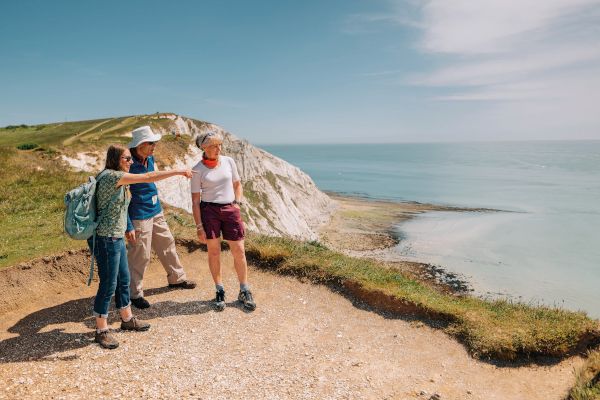
As I researched my most recent book, The Walking Cure, I was astonished to find remarkable benefits determined by the location or landscape of a walk. Not everyone can choose where they walk, but if you have hills in your vicinity, use them! When we walk both up- and downhill, we use different chains of muscles, so a hill walk always engages more of our body than merely walking on the flat. Studies also show that walking hills has a greater effect on our metabolism and heart – meaning reduced risk of cardiovascular disease and metabolic disorders such as diabetes.
Air quality matters, too. Recent studies have found that the air we breathe alters according to where we are, with coast, fresh water and woodlands (as well as moderate altitude) being particularly beneficial. You may be familiar with Japanese ‘forest bathing’ experiments, revealing that forest air contains anti-inflammatory and anti-cancerous volatile organic compounds (known as terpenes or phytoncides). If you’re lucky enough to have a choice, pick a woodland with plenty of conifers. Evergreens throw out more terpenes than other trees, although a recent Italian study found that the most terpene-rich forests were those containing a diverse range of trees. Larger, older trees have also been found to produce more phytoncides than trees less than 35 years old. Walking amplifies the benefits – there’s no need to ‘bathe’!
Intriguing new studies have found that coastal air is especially beneficial. Sea air contains tiny droplets of sea water, rich in iodine, magnesium, calcium and potassium. The magnesium content could explain why studies have found that people walking beside the sea typically sleep for 47 minutes longer than people walking elsewhere. Epidemiologists have known for a while that people living in coastal areas typically have better health – far fewer coastal inhabitants died of Covid, for example. For best results, choose a gusty day in which the nutrient-rich air is blowing inland.
To boot, it turns out that water-dwelling phytoplankton release anti-inflammatory and anti-cancerous molecules into the air – which we then inhale – meaning lake and river walks might have the same therapeutic results as a beach walk. A recent study found that lakeside amblers achieved complete relaxation more quickly than walkers in other environments. Three minutes of looking at still water was sufficient to dispel circulating stress hormones.
Many walkers head out in headphones, taking advantage of an amble to enjoy an audiobook, podcast or music. But it’s worth tuning in to the environment around you as well, for safety (it’s advisable to wear one rather than both earpods on roads) or to relax. Studies repeatedly show that natural sounds – particularly birdsong and water – reduce stress and lift our mood.
Avoid locations containing high levels of pollution (slow-moving or heavy traffic, for instance): medics are forecasting 30,000 UK deaths from toxic air in 2025 alone. Use a mapping app to find the greenest possible route. Scientists have linked even low concentrations of toxic air to cancer, heart disease, stroke, dementia and mental health conditions. Every time we walk rather than drive, we’re helping to reduce the burden of air pollution, too. And your body will thank you for taking a green route.

Style, speed and swing: hone your walking technique
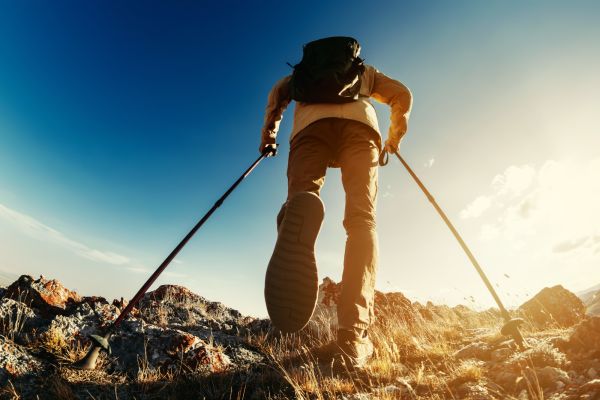
How we walk can also amplify the benefits. Swinging our arms improves our balance and helps work our abdominal muscles. Moving with good posture means that we breathe more fully, which is good for our respiratory health and feeling calm. Holding our head upright rather than looking down towards our feet means less strain on our neck. And walking with poles gives our body an even more comprehensive workout.
Rolling properly through the foot reduces the chance of foot pain. If you’re concerned about your gait, invest in a session with a walking coach or try Joanna Hall’s WalkActive programme.
What about frequency: how often should we be walking? It appears that rushing out at dawn for our 10,000 steps and then sitting in a chair all day isn’t the answer. In fact, all that sedentary chair-sitting wipes out many of the benefits accruing from our morning walk. We should move around every hour, even if that’s a short walk to the kettle.
Try breaking up your 10,000 steps into three or four shorter walks. Studies suggest that more frequent walking reduces blood pressure and insulin resistance. I like to do ‘micro walks’ of 10-30 seconds: tiny bursts of walking have been shown to improve focus and cognition.
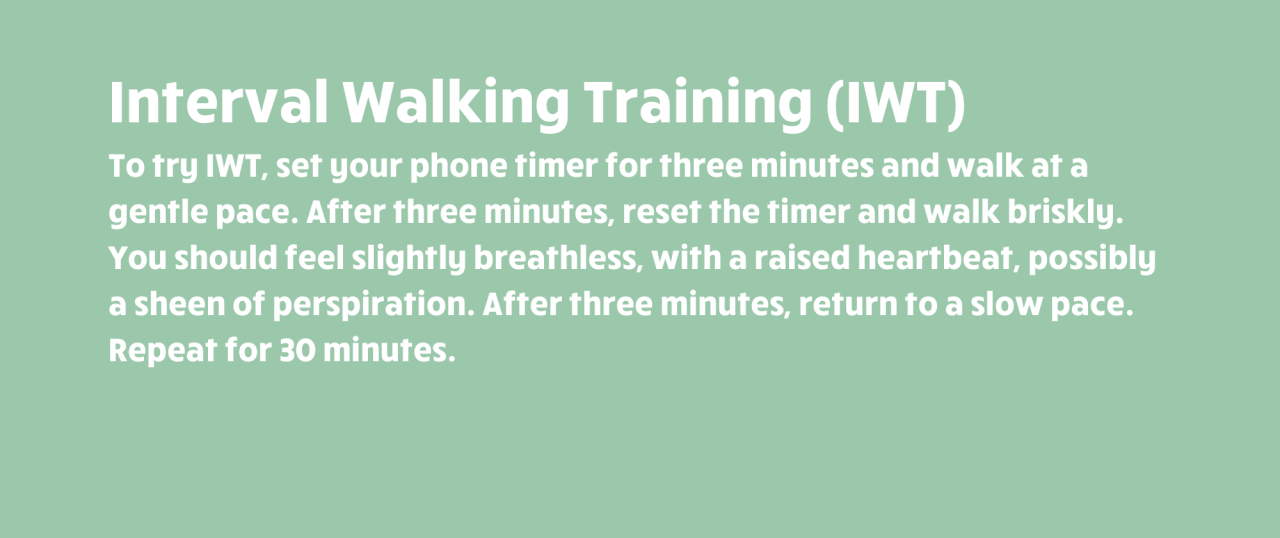
Finally, what about speed? It’s generally thought that brisk walking is best. But including short periods of fast walking in our rambles might be even better. A technique called interval walking training (IWT), co-developed by Japanese physiologist Dr Hiroshi Nose, has had excellent results, suggesting that mixing speeds is more effective at improving heart health, blood pressure, blood sugar and weight loss, in addition to improving balance, stability and lower body muscle strength. (See box-out.)
Having said all this, the one thing that every expert agrees on is… just walk!
Annabel Streets is the author of 52 Ways to Walk and Windswept: Why Women Walk (written as Annabel Abbs). Her latest book is The Walking Cure: Harness the Life-changing Power of Landscape to Heal, Energise and Inspire (£14.99, Bloomsbury, ISBN 978 1526676320).
Masterclass – Walking with poles
Get into pole position this autumn with top tips for choosing and using trekking poles for better balance, posture and efficiency on the trail.

Masterclass – Good in an emergency
Stay safe this season with expert advice on walking in wintry conditions and what to do in an emergency, from our friends at AdventureSmart.

Masterclass: Organising a walking festival
Walking festivals can help get people more active, attract visitors, boost the local economy and grow your Ramblers group, with socialising, learning and fun to be found along the way. If you’d like to set one up and need ideas, read on.