1
From the Argyle Street exit from Oxford Circus Underground Station turn left. Walk towards Liberty’s department store (A). At the road in front of it, turn right and walk to Regent Street. Cross over at the lights and turn right to Oxford Circus. Turn left along Oxford Street. Go past John Lewis, House of Fraser and Debenhams on the right and then immediately after Bond Street underground station turn sharp left down South Molten Street. Continue along the paved area past the expensive shops to the end.
(A) Liberty's was founded by Arthur Lasenby Liberty in 1875 with a loan of £2000 from his father-in –law. He took the lease out on half a shop in Regent Street. The Tudor revival building was built so that trading could continue while renovations were being completed on the other premises and in 1924 this store was constructed from the timbers of two ships: HMS Impregnable (formerly HMS Howe) and HMS Hindustan. The frontage on Great Marlborough Street is the same length as the Hindustan. It is a Grade II* listed building.(B) South Molten Street was built in the mid-18th century as part of the Conduit Mead Estate. It was extensively rebuilt about 1900 but many of the original Georgian houses remain The street is also home to award winning model agency Sapphires Model Management as well as fine art gallery Castle Galleries, and inspired fashion blog South Molton St Style in 2011
2
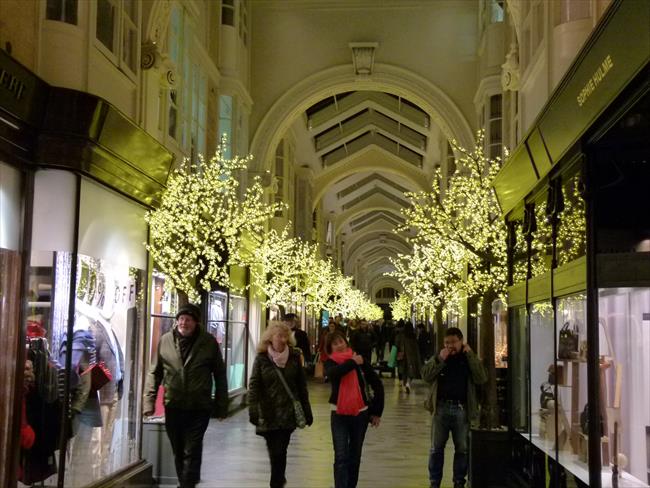
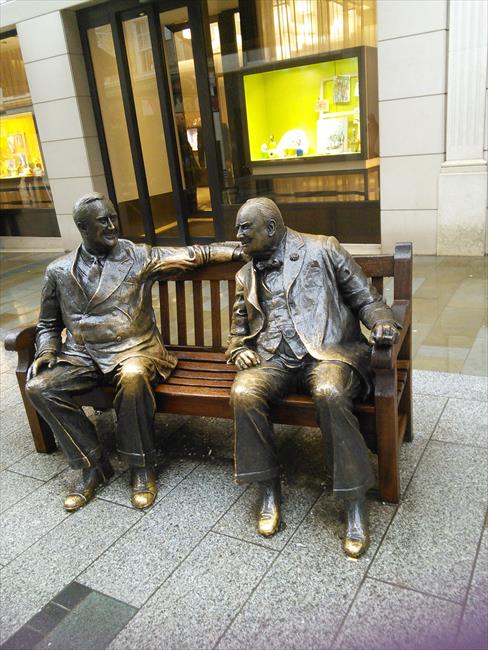
Look for Lancaster Court across the road and go down this alleyway. Follow it left past the Handel and Hendrix museum and then turn right past all the restaurant tables lining the passageway. Turn right and then left. Continue along New Bond Street (C), ignoring all turnings until you reach Burlington Gardens. Enjoy all the designer shops and art galleries, noting Sotheby's, the auctioneers, on the left and Churchill and Roosevelt chatting on a bench on the pedestrianised section. When you reach Burlington Gardens, turn left and then right down Burlington Arcade (D). This brings you to Piccadilly. Cross over to go down Piccadilly Arcade opposite. (If the traffic is heavy, use the traffic lights to your right and from there you can admire the lights in Bond Street at Christmas Time).
(C) New Bond Street is one of the most expensive streets of real estate in the World. Named after Sir Thomas Bond, head of a syndicate of developers who purchased a Piccadilly mansion Clarendon House, from 2nd Duke of Albemarle in 1683(D) Burlington Arcade was built by Lord George Cavendish who lived in adjacent Burlington House, to stop people throwing oyster shells and rubbish over the wall into his garden.
3
At the end, admire the statue of Beau Brummel, leader of fashion, and then turn left along Jermyn Street (E). Walk past Fortnum & Mason's on the left (F) and continue across Regent Street to the end on Haymarket. Turn right to the lights and cross left to go down Panton Street. Cross over Oxendon and Whitcomb Streets and turn left along the side of Leicester Square (G). At the top, continue in the same direction along Leicester Street. This leads to Lisle Street. Turn right and walk past Chinese Restaurants on the left. (this is the edge of China Town). Go left into Newport Place and then sharp right along Newport Court
(E) Jermyn Street is a street of up market gentlemen‘s outfitters. Statue of George Bryan “Beau” Brumell (1778-1840), friend of Prince Regent, George IV. Introduced modern men’s suit with a necktie. Claimed to have taken 5 hours to dress and polish his boots with champagne.(F) Established in 1707 by William Fortnam and Hugh Mason. It is the Queen’s grocers.(G)The land where Leicester Square now lies once belonged to the Abbot and Convent of Westminster Abbey and the Beaumont family. In 1536, Henry VIII took control of 3 acres of land around the square, with the remaining 4 acres being transferred to the king the following year. The square is named after Robert Sidney, 2nd Earl of Leicester, who purchased this land in 1630. By 1635, he had built himself a large house, Leicester House, at the northern end. The area in front of the house was then enclosed, depriving inhabitants of St Martin in the Fields parish of their right to use the previously common land. The parishioners appealed to King Charles I, and he appointed three members of the Privy Council to arbitrate. Lord Leicester was ordered to keep part of his land (thereafter known as Leicester Fields and later as Leicester Square) open for the parishioners
4
Walk down Newport Court to Charing Cross Road. Cross over and continue down Great Newport Street to a big junction. Take the second left, Long Acre. Just past Covent Garden Station turn right into James Street (H). This leads to Covent Garden. Go into the building to the central aisle and turn left. On exiting, go straight ahead along Russell Street.
(H) The land, now called "the Covent Garden", was seized by Henry VIII, and granted to the Earls of Bedford in 1552. The 4th Earl commissioned Inigo Jones to build some fine houses to attract wealthy tenants. Jones designed the Italianate arcaded square along with the church of St Paul's, the actors' church.Gradually, both the market and the surrounding area fell into disrepute, as taverns, theatres, coffee-houses and brothels opened up; the gentry moved away, and rakes, wits and playwrights moved in. By the 18th century it had become a well-known red-light district, attracting notable prostitutes. An Act of Parliament was drawn up to control the area, and Charles Fowler's neo-classical building was erected in 1830 to cover and help organise the market. The area declined as a pleasure-ground as the fruit, vegetable and flower market grew and further buildings were added: the Floral Hall, Charter Market, and in 1904 the Jubilee Market. By the end of the 1960s traffic congestion was causing problems, and in 1974 the market relocated to the New Covent Garden Market about three miles (5 km) south-west at Nine Elms. The central building re-opened as a shopping centre in 1980.
5
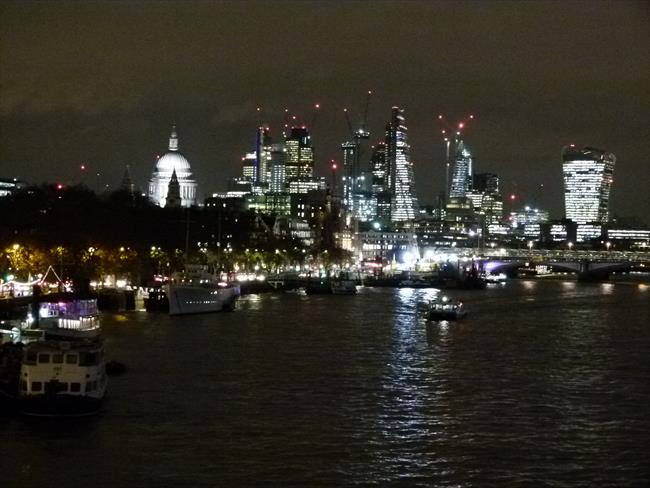
Turn first right into Wellington Street. Walk past the Lyceum Theatre (I) on the right to reach a busy junction with the Strand and Aldwych, Cross over to walk down the left side of Lancaster Place opposite and then over Waterloo Bridge. Here there are great views of the City of London one side and Westminster on the other. On the far side, go down steps on the left by a bus stop. Turn to the river and go under the bridge and walk along the South Bank past the Festival Hall and under Hungerford rail bridge. Take the steps on the far side to cross on the pedestrian bridge and to see the Parliament Buildings on the left. At far end you arrive near a large arch that leads to Embankment Station
(I) The origins of the Lyceum theatre date to 1765 hosting a variety of entertainments including a circus and the first London exhibition of waxworks displayed by Madame Tussaud. From 1816 to 1830, it served as The English Opera House. After a fire, the house was rebuilt and reopened on 14 July 1834 The building was unique in that it has a balcony overhanging the dress circle. In 1904 the theatre was almost completely rebuilt and richly ornamented in Rococo. The building closed in 1939 and was set to be demolished, but it was saved and converted into a Mecca Ballroom in 1951, styled the Lyceum Ballroom, where many well-known bands played. The Lyceum was closed in 1986 but restored to theatrical use in 1996 by Holohan Architects.
Watch out for cyclists at the end of Wellington Street
6
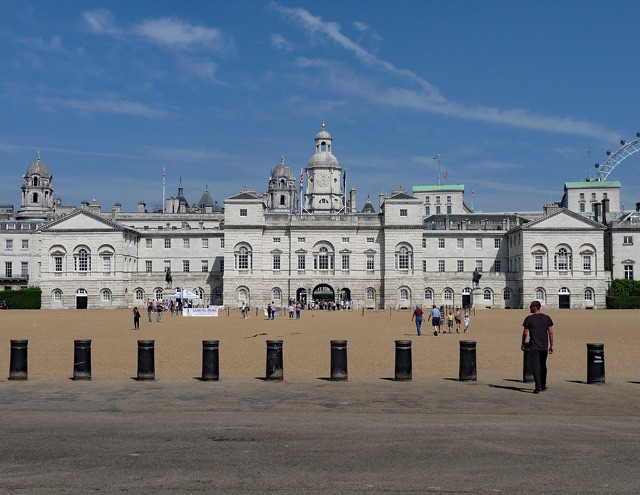
Ahead is the Playhouse Theatre. Cross over the road, Northumberland Avenue, to go down Whitehall Place on the left. At the end, turn left to cross Whitehall at the pedestrian lights and walk through the gates and under Horse Guard buildings to the parade ground. Cross this, walk across the road and enter St James Park through the gates. Turn left and follow path by lake until you reach a crossroad with a footbridge over the lake on the right with a good view of Buckingham Palace. Do not cross but turn left here and follow the path out of the park. Cross over at traffic lights and go up path opposite. (Queen Anne's Gate.) Continue ahead to reach St James Park underground station
(J) Horse Guards was built in the mid-18th century, replacing an earlier building, as a barracks and stables for the Household Cavalry, later becoming an important military headquarters. Horse Guards originally formed the entrance to the Palace of Whitehall and later St James's Palace; for that reason it is still ceremonially defended by the Queen's Life Guard. Although still in military use, part of the building houses the Household Cavalry Museum which is open to the public.
If Horse Guards is shut, continue along Whitehall, past Downing Street to King Charles Street. Turn right and walk down to the end. Go down Clive Steps and cross over road into St James Park and the path round the lake. If you are walking this at night to enjoy the Christmas Illuminations, either skirt the park on the road, turning left and then right or choose a path just inside the park. Cross Birdcage Walk at the lights by the park exit with a map board and go up path opposite. (Queen Anne's Gate.)