


10 tips on guiding someone who is blind or visually impaired
How to have an enjoyable and safe walk. Produced with input from Sight Support West of England and British Blind Sport.

For a person who is blind or visually impaired, enjoying walking in nature can be a rich and sensory experience.
Guiding a walking companion who is blind or visually impaired can be hugely rewarding for both of you. If you are new to sighted guiding or if you’ve been a sighted guide before and need a reminder, read on for 10 tips that should help you and your companion have a safe and enjoyable walk.
Amar Latif, President of the Ramblers and blind adventurer says, “I like a walk where I can hear the nature, smell the wildflowers. I love going to Nidderdale where there is peace and quiet, and sheep and cattle roaming free. I love the sound of a trickling river. It makes me feel so zen.”

How sight loss can affect vision
Sight loss can mean total blindness but more common are central vision loss or peripheral vision loss.
Someone with central vision loss may not see details well, if at all. They may, for example, be able to see the outline of a person's figure but may not be able to see what they look like.
Whilst their sight may not be perfect, it may still be used to do many everyday tasks and to move around relatively freely.
Someone with peripheral vision loss may struggle to move around freely, especially in busier areas. They may not see things on the immediate left- or right-hand side or in the distance.
10 tips for guiding a person who is blind or visually impaired when out walking
Here are 10 tips to consider to help you make it a safe and enjoyable experience:
Before the walk
-
Everyone is different so the most important thing is to get to know the person you are guiding. Ask the person about the types of walks they enjoy, what level of sight they have and how they would like to be guided. Some people with a visual impairment use walking sticks and might prefer more verbal guidance rather than needing a shoulder or arm to hold onto
-
When arranging to meet, try to come up with a place to meet that you both know or that a taxi driver would be able to find easily. A person with a visual impairment may not be able to recognise you and may be expecting you to find them. Remember to always introduce yourself by name.
During the walk
-
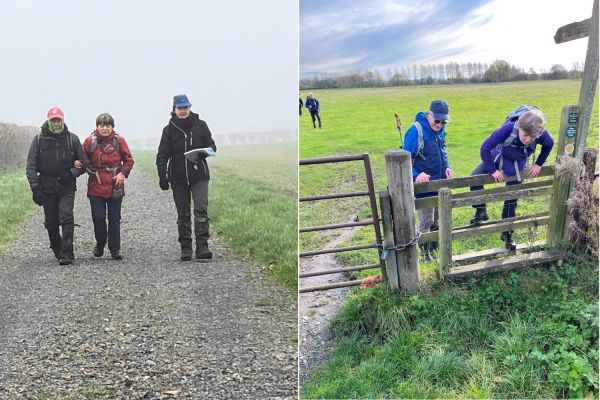
When following a path ask the person how they would like to be guided. The person being guided will likely want to have their hand on either your elbow or your shoulder. This allows them to feel movement and change of direction. They will follow roughly half a step behind.
-
Consider using a Ramble Tag or a running tether. People who are blind or partially sighted may use any of a variety of different canes to support their mobility. But when rambling in the countryside, many people use a Ramble Tag or a Running Tether. A tether is attached to the guide, and the person being guided will hold on to the other end.
-
Converse just as you would with anyone else. People who are blind or partially sighted do not want to be talked to any differently. Asking if they saw a particular TV programme last night is perfectly acceptable.
-
Look out for tricky terrain and let your companion know what you are approaching. Inclines, cobbled paving, loose stones, uneven ground and muddy paths can all be hazards.
-
Beware of overhanging trees. Make your companion aware just before you approach the obstacle and tell them you are navigating around it or ask them to duck. If you choose to duck, make sure to tell them once you have cleared the obstacle.
-
When approaching steps, walk ahead of the person you are guiding and let them know when you are at either the top or the bottom. If there is a handrail, ensure they know where it is and guide their hand to it if needed. Some people may prefer to continue being guided by you. Let them know when they’re at the last step.
- Think about describing your surroundings such as landmarks or an interesting skyline. President of the Ramblers, Amar Latif says “When I am on a walk, I get my sighted companions to build a picture for me. And that is just like reading a book. You are building the pictures yourself. And often the book is much better than the film.” Use clear imaginative words to bring the scene to life as if you are describing the scene to someone on the phone. Some people may even ask you to ‘draw’ the outline or shape by guiding their hand in the air.
After the walk
- Make sure your companion is safe before you leave. Leave them in a place that they are familiar with or ask if they need support in getting to public transport or a taxi. Always remember to say goodbye. If for any reason you must leave them (for example to go to the toilet) let them know that you are leaving and re-introduce yourself when you get back.
These tips should help you and your companion have a safe and enjoyable walk. But everyone is different so the most important thing is to get to know the person you are guiding and ask how they would like to be guided.
More inspiration
In this video Amar Latif, President of the Ramblers, explains how to guide a person who is blind or partially sighted.

Amar Latif to be appointed as President of the Ramblers
Known for his television appearances as the Blind Adventurer, Amar hasn’t let sight loss be a barrier to walking outdoors.
Walking is about more than what you can see
Ramblers member Marika has been blind since childhood, but that hasn’t stopped her from enjoying walking.